
The UK's New Vaping Tax from October 2026: What Retailers & Consumers Need to Know
 Introduction
From 1 October 2026, the UK Government is introducing a brand-new excise tax on vaping products, known as Vaping Products Duty (VPD). This is a major policy change that will affect manufacturers, importers, retailers, and ultimately customers across the UK.
Unlike today — where vaping products are only subject to standard VAT — the new duty will apply specifically to vaping liquids and is designed to make vaping less affordable for non-smokers and younger users while still maintaining incentives for smokers to switch to vaping instead of cigarettes.
What Is the Vaping Products Duty (VPD)?
The Vaping Products Duty is a new excise tax that will apply to all vaping liquids that:
- contain nicotine, and/or
- include glycerine, glycol, or similar substances intended to be vapourised, and
- are not classified as tobacco or medicinal products.
This duty will be charged on products manufactured in or imported into the UK.
When Does the Tax Start?
Key dates for businesses and retailers:
🗓 1 April 2026 — Businesses must apply for approval under the duty and stamps schemes to be ready to trade legally once the tax starts.
🗓 1 October 2026 — The Vaping Products Duty and the accompanying Vaping Duty Stamps (VDS) scheme become operational. All products sold must have duty paid and duty stamps affixed.
🗓 1 April 2027 — All vaping products must carry a duty stamp to be lawfully sold. Unstamped products will be prohibited thereafter.
How Much Will the New Tax Be?
Under current official proposals outlined by the UK Government:
📌 Flat-Rate System (Simplified)
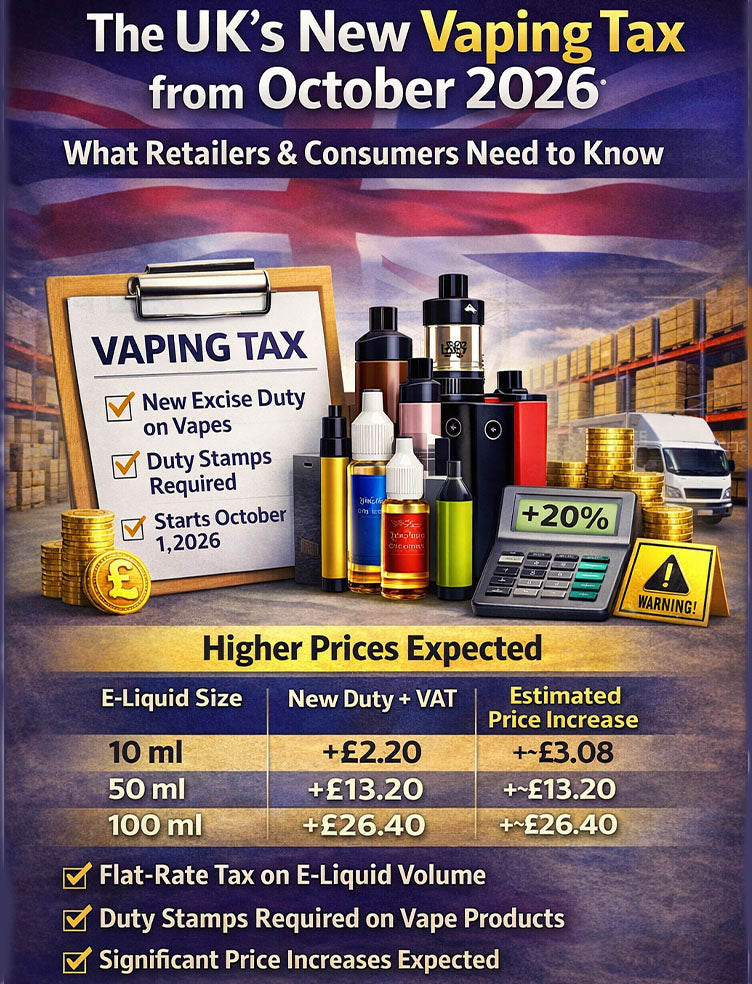
The duty is set at a flat rate of £2.20 per 10 ml of vaping liquid, regardless of nicotine content.
This means:
- A 2 ml pre-filled pod will attract 44 p of duty (+20% VAT on the final price).
- A 10 ml bottle of e-liquid will attract £2.20 of duty (+20% VAT).
Official documents note the flat rate system replaces earlier tiered proposals, simplifying compliance and aligning with international practice.
Estimated Price Impacts
Because duty is charged on the volume of liquid, the larger the bottle, the greater the tax impact:
| Product | Approx Duty | VAT (20%) | Estimated Price Increase |
|---|---|---|---|
| 10 ml e-liquid | £2.20 | £0.88 | +~£3.08 |
| 50 ml e-liquid | £11.00 | £2.20 | +~£13.20 |
| 100 ml e-liquid | £22.00 | £4.40 | +~£26.40 |
Duty + VAT estimated assuming full pass-through to retail price.
This means some products could increase in price by 50%–200% compared with today's rates — especially larger bottles.
Duty Stamps: What They Mean for Retailers
In addition to the duty itself, the Government is introducing a Vaping Duty Stamps (VDS) scheme to ensure compliance and help enforcement.
How the Stamps Scheme Works
- All legally sold vaping products must carry a duty stamp on final retail packaging from 1 October 2026.
- Businesses must apply for approval to use these stamps from 1 April 2026.
- After 1 April 2027, unstamped products will no longer be allowed on the UK market.
This is similar to other excise regimes like tobacco stamps and significantly increases oversight.
Why the Government Is Introducing the Tax
The official rationale provided by HM Revenue & Customs and the Treasury includes:
🧠 Public Health Objectives
Reduce the affordability and appeal of vaping products to non-smokers and young people.
💷 Revenue Generation
The duty is forecast to generate significant revenue, contributing to public funds while balancing health objectives.
⚖️ Maintain Incentive to Switch
Tobacco duty will be increased by a similar amount at the same time to ensure vaping remains cheaper than smoking.
Compliance & Enforcement
Retailers and wholesalers need to prepare now:
📍 Registration
Apply for duty and stamps approval as early as possible in 2026 to avoid delays.
🏷 Labeling
Duty stamps must be affixed to retail packaging once the scheme starts.
📦 Penalties
Selling unstamped products after the compliance date (after April 2027) may lead to civil or criminal penalties.
What It Means for Retailers and Consumers
🔹 Higher Retail Prices
Consumers can expect higher prices on all vaping liquids from late 2026 onward due to the combined duty + VAT.
🔹 Inventory Planning
Retailers should plan stock carefully before October 2026 to manage price increases and avoid compliance issues.
🔹 Smaller Vapes or Shortfills
Larger bottles will attract more tax — product mix, such as shortfills, might shift.
Final Thoughts
The introduction of the Vaping Products Duty and accompanying duty stamps scheme marks a major shift in how vaping products are taxed and regulated in the UK. Retailers and wholesalers must prepare well ahead of 1 October 2026, while consumers should expect significantly higher prices, especially on larger e-liquid bottles.
Stay informed and ensure your business is ready for these changes. For wholesale retailers looking to navigate the new tax landscape, working with compliant UK suppliers will be more important than ever.
-
Posted in
duty stamps, October 2026, UK retailers, vape regulations, vaping products duty, vaping tax UK, VPD